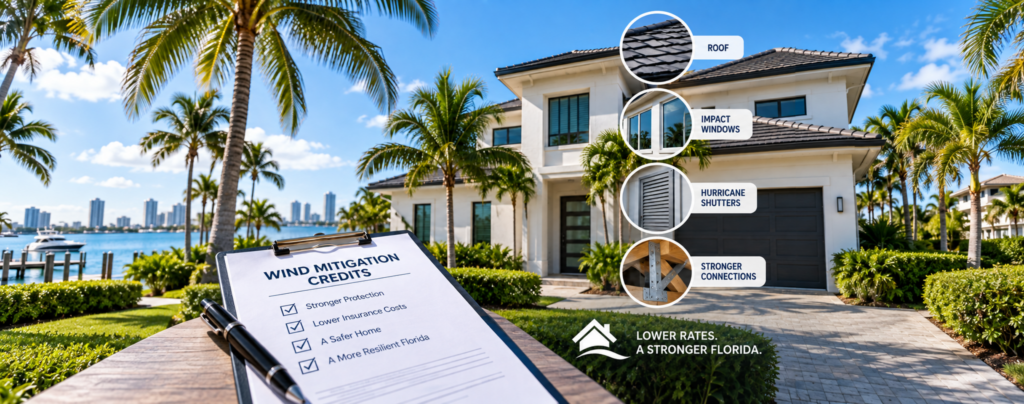
Florida changed its standard residential wind-mitigation inspection form in 2026.
The revised Uniform Mitigation Verification Inspection Form, OIR-B1-1802 (Rev. 04/26), became effective April 1, 2026.
For homeowners replacing impact windows or doors, the important lesson is not to chase a guaranteed insurance percentage. It is to make sure the home’s mitigation features can be documented correctly by an authorized inspector.
What is OIR-B1-1802?
OIR-B1-1802 is Florida’s Uniform Mitigation Verification Inspection Form.
An authorized inspector uses it to document wind-resistant features of eligible residential buildings for insurance purposes.
The form covers more than windows. It evaluates building characteristics such as roof construction and opening protection as part of a larger mitigation profile.
That is why a window contractor cannot promise a specific premium result from the window project alone.
Our impact windows and Florida insurance guide explains that distinction.
What changed in 2026?
Florida’s Office of Insurance Regulation says the revised form became effective April 1, 2026.
The Department of Financial Services also states that inspections performed from that date forward must use the new OIR-B1-1802 (Rev. 04/26).
Citizens separately explains that an older form completed before April 1, 2026 can still be accepted in certain circumstances when it remains within its validity period and no material changes have been made.
For a new inspection today, use the current form.
How long is a wind mitigation form valid?
Florida OIR states that the form is valid for up to five years, provided no material changes are made to the structure and no inaccuracies are found.
That does not mean every insurer must treat every old inspection identically after a major renovation.
If you replace windows, doors, roof components or other mitigation features, ask the insurer or agent whether updated documentation is needed.
How do impact windows relate to opening protection?
Impact windows can be part of the opening-protection section, but the inspector must verify the actual installed condition.
Useful supporting records can include:
- Product approval documents
- Permit records
- Final inspection or closeout
- Manufacturer labels
- Glass etching or product identification
- Photos of installed openings
- Documentation for shutters or other protected openings
- Door and garage-door protection records
The classification depends on what the authorized inspector can verify across the property.
Why does whole-home documentation matter?
A home can have strong impact windows and still have other exterior openings that affect the inspection result.
Examples include:
- Entry doors
- French doors
- Sliding glass doors
- Garage doors
- Skylights
- Unprotected windows
- Openings protected by shutters or panels
Do not assume replacing only one group of windows automatically creates the same opening-protection classification as a fully documented protection strategy.
Who can perform the inspection?
Florida law and DFS guidance specify categories of authorized inspectors.
Homeowners should verify that the inspector is legally authorized and that the professional license, when required, is active.
The insurer may also have the right to verify the inspection independently.
Should I schedule the wind mitigation inspection before or after window replacement?
If the goal is to document newly installed mitigation features, the inspection normally needs to reflect the completed condition.
Complete the permitted work, required inspections and closeout first, then coordinate the wind-mitigation inspection with the appropriate professional and insurer.
Keep the project records so the inspector does not have to reconstruct the installation from memory.
What should homeowners ask their insurer?
Ask:
- Do you need a new OIR-B1-1802 after this project?
- Which form revision do you currently require?
- What documentation should I provide?
- Does the insurer need permit or product-approval records?
- How are partially protected openings treated?
- When will updated mitigation information be reviewed?
- Does the insurer require any additional inspection?
Avoid treating a contractor’s estimate of savings as an insurance determination.
Frequently asked questions
When did the new OIR-B1-1802 take effect?
The revised OIR-B1-1802 (Rev. 04/26) took effect April 1, 2026.
Is the form valid forever?
No. OIR states it is valid for up to five years if there are no material changes or inaccuracies.
Do impact windows guarantee an insurance discount?
No. Eligibility and premium effects depend on the verified mitigation characteristics, insurer, policy and rating plan.
Can an old form still be used?
Citizens states that certain older forms completed before April 1, 2026 may remain acceptable if they are still within the validity period and no material changes were made. Confirm with the actual insurer.
Authoritative sources
- Florida Office of Insurance Regulation — Wind Mitigation Resources
- Florida Department of Financial Services — Mitigation Notices, Inspections and Forms
- Citizens — Uniform Mitigation Verification Inspection Form Changes
- Florida Statutes §627.711
The bottom line
The 2026 OIR-B1-1802 update makes current documentation even more important. Finish the project correctly, preserve permits and product records, and let an authorized inspector and insurer determine how the installed protection is classified.
AA Glass & Windows can help organize impact-window and door project documentation before closeout. Request a free estimate to discuss your project.