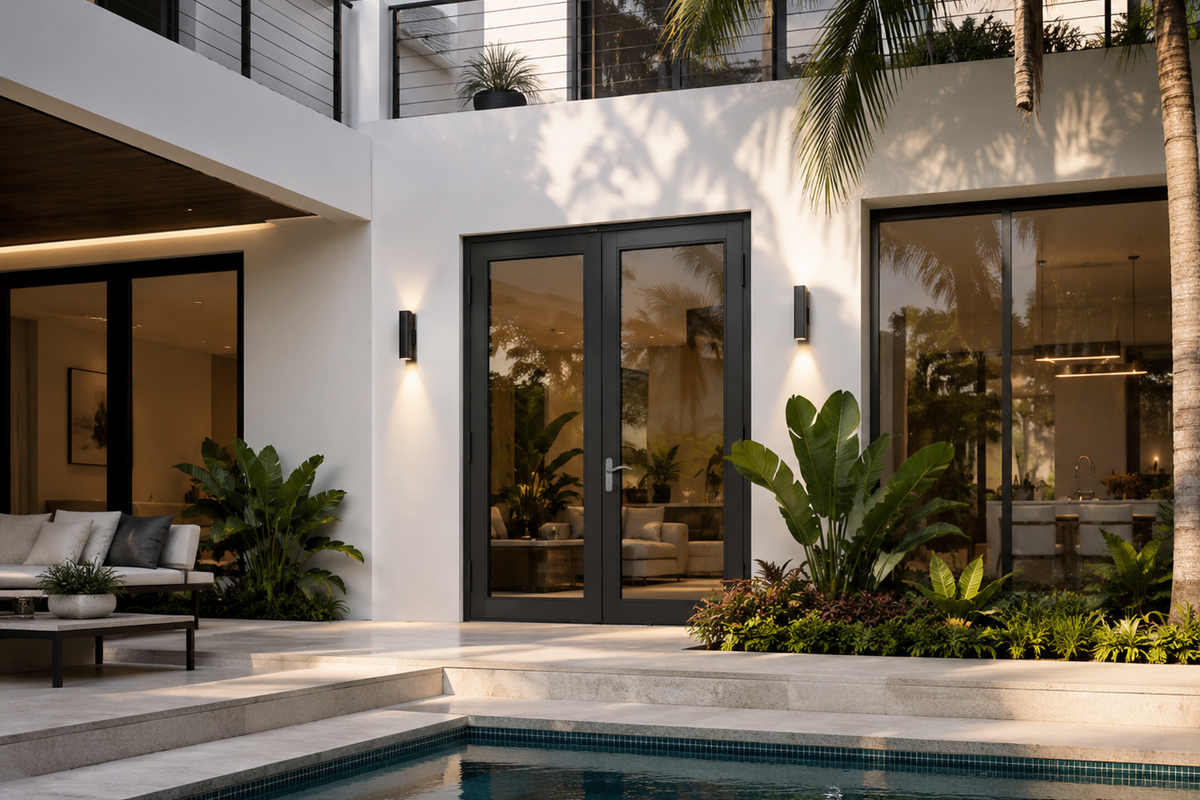
Impact doors and standard exterior doors can look surprisingly similar in a showroom. Both can be made from aluminum, steel, fiberglass, wood, or combinations of materials. Both can include decorative glass, modern hardware, multiple panels, or large openings. The meaningful difference is not simply appearance or material. It is what the complete door system has been tested and approved to do.
For Florida homeowners, that distinction matters because an exterior door can be part of the building envelope exposed to wind pressure, wind-driven rain, and, in some locations and projects, wind-borne debris requirements. A product marketed as an impact or hurricane door should have approval documentation supporting that claim for the intended use.
This guide compares impact doors vs. regular doors without assuming that every Florida home has the same code requirement or that every impact-rated product is appropriate for every opening. The right choice depends on the property, jurisdiction, opening, exposure, product approval, design pressure, installation conditions, budget, and the homeowner’s priorities.
If you want a broader overview of the everyday advantages of impact-rated entry and patio systems, see our guide to the benefits of impact doors for Florida homes. This article focuses specifically on the buying decision between an impact-rated system and a conventional exterior door.
Quick answer: what is the difference between an impact door and a regular door?
An impact door is an exterior door system with documented testing and approval for impact or wind-borne-debris protection under the conditions listed in its approval. Depending on the product, the approved assembly can include the door panel, frame, glass, glazing system, anchors, hardware, mullions, thresholds, and other components.
A regular door is a broad consumer term, not one technical category in the Florida Building Code. A conventional exterior door may still be strong, attractive, energy efficient, and code compliant for a particular application, but it should not be assumed to provide hurricane-impact protection unless its approval documentation says that it does.
That leads to the most important rule when comparing doors:
Do not judge hurricane or impact performance from the door’s appearance, weight, material, brand name, or sales description alone. Verify the exact approved system and its limits of use.
Florida law requires statewide product-approval methods for categories including exterior doors, windows, shutters, and impact-protective systems, and it restricts marketing products as hurricane, windstorm, or impact protection unless the applicable approval requirements are met.
Impact doors vs. regular doors at a glance
| Comparison point | Impact-rated exterior door | Conventional exterior door |
|---|---|---|
| Wind-borne debris protection | Documented when the exact approved system is impact rated | Should not be assumed unless approval specifically identifies impact resistance |
| Wind/design pressure | Must be checked against the approval and project requirements | Also must meet applicable pressure/code requirements for the project |
| Glass | Impact-rated glazing when required by the approved system | May use standard, tempered, laminated, insulated, decorative, or other glazing depending on product |
| Florida Product Approval / NOA | Approval should document applicable impact and use conditions | Exterior doors may still require product approval even when not impact rated |
| Storm preparation | Permanent protection can eliminate a separate covering for that approved opening | A glazed opening may require an approved impact-resistant covering where code requires debris protection |
| Security | May provide a more resistant assembly, but security performance varies by product | Can also offer strong locks and construction; security is not determined by the word “impact” alone |
| Energy performance | Depends on the exact door, frame, glass and ratings | Also depends on exact product; impact rating is not an energy rating |
| Upfront cost | Often higher because of testing, glazing, framing and system requirements | Can be lower, but pricing varies widely by style, material and installation |
| Installation | Must follow the approved system and opening conditions | Must also be installed to applicable code, approval and manufacturer requirements |
The table is a planning summary, not a substitute for reviewing the exact product approval and permitted project documents.
1. The biggest difference is documented storm performance
The word impact should describe tested performance, not a visual style.
Florida’s statewide product-approval framework covers exterior doors and impact-protective systems. The official Florida Building Commission Product Approval Search lets users review fields such as:
- Product manufacturer and model
- Code version
- Approval status
- Approved for use in the High-Velocity Hurricane Zone (HVHZ)
- Approved for use outside the HVHZ
- Impact Resistant status
- Positive and negative design pressures
- Product descriptions and supporting documents
Those details are much more useful than a generic statement such as “hurricane door” or “Florida approved.”
The current Florida Product Approval database identifies the 2023 Florida Building Code as the current search code version, and the Florida Building Commission states that the Florida Building Code, 8th Edition (2023) became effective December 31, 2023.
2. A regular exterior door can still require product approval
One common misconception is that product approvals matter only for impact products. That is not correct.
Florida Statute §553.842 identifies exterior doors as one of the product categories subject to the statewide product-evaluation and approval system. In Miami-Dade County, current exterior-door replacement guidance also calls for product approval numbers and the applicable current Notice of Acceptance or Florida Building Commission approval.
So the comparison is not:
- impact door = approved product
- regular door = no documentation needed
A better comparison is:
- impact-rated door = approval documentation confirms impact protection for specified conditions
- non-impact or conventional exterior door = may still need approval and must still satisfy the applicable project requirements, but impact protection should not be assumed
3. Glazed doors create an additional opening-protection question
A solid exterior door and a door with substantial glass are not identical from an opening-protection standpoint.
The Florida Building Code includes wind-borne-debris protection requirements for glazed openings in applicable regions and conditions. Depending on the project, a glazed opening can be protected by an impact-resistant product or by an approved impact-resistant covering.
That is why a homeowner comparing a standard glass door with an impact glass door should ask two separate questions:
- Is this exact door approved for the wind pressure and installation conditions of my opening?
- If wind-borne-debris protection is required, how will the glazed opening satisfy that requirement?
An impact-rated glazed door can provide permanent protection as part of the approved assembly. A non-impact glazed door may require an approved shutter, panel, or other qualifying protection method when the code and project conditions require debris protection.
Our impact windows vs. hurricane shutters guide explains the same permanent-versus-deployable protection concept for windows.
4. Impact glass is not simply “thicker glass”
Homeowners sometimes try to identify impact performance by looking at glass thickness, tint, pane count, or how heavy the door feels. None of those observations is enough on its own.
Impact performance belongs to the approved system. For a glazed impact door, the glass construction, interlayer, frame, glazing method, anchors, hardware, dimensions and approved installation all work together.
A double-pane door is not automatically impact rated. A laminated-glass door is not automatically approved for every hurricane application. Tempered glass alone does not establish wind-borne-debris impact approval.
The reliable approach is to verify the approval record for the exact door system rather than trying to infer performance from appearance.
5. Design pressure still matters even when a door is impact rated
Impact resistance and design pressure are related to storm performance, but they are not the same measurement.
A door can be listed as impact resistant and still have limits on:
- Positive design pressure
- Negative design pressure
- Maximum width or height
- Single-door versus double-door configurations
- Inswing or outswing use
- Glass options
- Mullions
- Frame conditions
- Substrate
- Fasteners and anchoring
- Edge distances
- HVHZ use
The Florida Product Approval Search exposes positive and negative design-pressure fields because the product must be evaluated against the actual project conditions.
This is one reason a contractor should not select a door by brand and size alone. The exact opening needs to be matched with the appropriate approved configuration.
6. Miami-Dade and Broward require especially careful document review
Miami-Dade and Broward counties make up Florida’s High-Velocity Hurricane Zone. Homeowners in these counties should pay particular attention to whether the exact product approval is valid for HVHZ use and what limitations apply.
Miami-Dade County’s current permitting guidance for exterior door replacements requires the sizes and product approval numbers of the doors being replaced and calls for the applicable current NOA. The same page states that applicable Florida Building Commission product approvals are acceptable.
This is an important nuance: do not assume that only one approval label or approval pathway can ever be used in the HVHZ. Check the exact current approval, its HVHZ status, and the local permit requirements for the project.
7. Permanent protection is one of the strongest practical advantages of an impact door
When an approved impact door provides the required protection for the opening, the protection is built into the installed system. There is no separate shutter panel to retrieve, mount, remove, label, store, or maintain for that opening.
That can matter for:
- Primary residences
- Seasonal homes
- Rental properties
- Older homeowners
- Multi-story properties
- Homes where storm preparation time is limited
- Large patio or entry openings
A conventional glazed door protected by approved shutters can still be a legitimate strategy where permitted and properly designed, but it adds a deployment and maintenance step before severe weather.
For a broader storm-readiness checklist, see our Florida hurricane-season home preparation guide.
8. Security can improve, but “impact” is not a universal burglary rating
Impact-rated glass and reinforced assemblies can make an exterior opening more resistant to breakage than ordinary glazing. That can be a useful everyday security benefit.
However, homeowners should avoid converting that general advantage into an unsupported claim such as “impact doors are burglar proof.”
Real security depends on the complete assembly, including:
- Door construction
- Frame strength
- Glass configuration
- Locks
- Multi-point hardware when provided
- Hinges
- Strike attachment
- Anchoring
- Adjacent sidelites or transoms
- Installation quality
A high-quality conventional solid door with strong hardware can also provide good everyday security. If forced-entry resistance is a priority, ask for documentation specific to that performance rather than assuming the hurricane-impact approval answers every security question.
9. Energy efficiency is separate from impact resistance
A door can be excellent at storm protection and average at energy performance, or vice versa.
Impact approval does not automatically establish:
- U-factor
- Solar Heat Gain Coefficient (SHGC)
- Air leakage
- Visible transmittance
- Insulation level
- ENERGY STAR qualification
Those characteristics depend on the exact door, frame, glass package, weatherstripping, threshold, installation and tested ratings.
For glass-heavy entry, French, pivot, and sliding door systems in Florida, solar heat gain can be especially important. Homeowners comparing products should review the actual energy-performance documentation rather than relying on the word “impact.”
The same principle applies to windows; our impact-window energy-efficiency guide explains why impact performance and energy performance should be evaluated separately.
10. Noise reduction also depends on the exact assembly
Laminated impact glass can contribute to better sound control, but not every impact door has the same acoustic performance.
Sound transmission can be affected by:
- Glass make-up
- Air space in insulated glazing
- Door size
- Frame
- Weatherstripping
- Threshold seal
- Installation gaps
- Adjacent walls and windows
If noise is a major reason for replacement, ask for acoustic data for the proposed configuration instead of assuming all impact doors will produce the same result.
11. Durability depends on materials, finish and exposure—not just the rating
Florida exposes exterior products to strong sun, humidity, rain, salt air in coastal locations, and heavy daily use. Impact approval does not make every finish or component maintenance-free.
When comparing doors, evaluate:
- Frame and panel material
- Finish warranty
- Coastal or salt-air suitability
- Hardware finish
- Corrosion resistance
- Threshold material
- Weatherstripping replacement
- Glass and seal warranties
- Drainage and water-management details
- Manufacturer maintenance instructions
A properly selected conventional door can be durable. A poorly maintained impact door can deteriorate. Product rating and long-term maintenance are separate decisions.
12. Impact doors often cost more upfront, but price alone is a poor comparison
It is reasonable to expect many impact-rated systems to carry a higher initial cost because they can involve specialized glazing, reinforced components, testing, approvals and more demanding installation requirements. But there is no responsible universal percentage or price multiplier for “impact vs. regular” doors.
The quote can change substantially based on:
- Door style
- Opening size
- Single versus double door
- French, sliding, pivot or bi-fold configuration
- Amount and type of glass
- Frame material
- Finish
- Hardware
- Product approval
- Design pressure
- Structural opening conditions
- Permit requirements
- Stucco, drywall, trim or paint work
- HOA or condo requirements
- Access and labor complexity
Compare the complete installed scope, not just the unit price.
Florida also currently has a separate home-hardening sales-tax refund program for qualifying purchases and eligible properties. The rules, dates and eligibility are specific, so do not assume every impact-door purchase automatically qualifies. See our Florida home-hardening sales-tax refund guide for the current program details.
13. A standard door plus shutters can be a rational choice in some projects
Impact-rated doors are not the only possible strategy for every Florida property.
A conventional exterior door may still make sense when:
- Impact protection is not required for that specific opening and project
- The opening is protected by an approved shutter or other permitted system where required
- The homeowner already has a complete maintained shutter strategy
- Budget requires a phased mitigation plan
- Architectural or historic constraints limit available impact products
- The exact impact product needed for the opening is unavailable
- A project professional or building official confirms another compliant solution
The critical point is not to substitute a homeowner assumption for project-specific code review.
14. When an impact door is often the stronger fit
An impact-rated system can be especially attractive when the homeowner wants:
- Permanent storm protection at the opening
- Less pre-storm deployment work
- Large areas of exterior glass without separate shutter installation
- A coordinated windows-and-doors mitigation project
- Verified impact protection documented in the product approval
- A modern entry, French, patio, pivot, or sliding-door upgrade that combines aesthetics with storm performance
Explore AA Glass & Windows’ impact door services or compare specific styles such as French doors, pivot doors, sliding glass doors, and bi-fold doors.
15. The installation is part of the approved system
Buying an impact-rated door does not guarantee that the installed opening will perform as intended.
The contractor still needs to address:
- Field measurements
- Existing opening condition
- Substrate
- Anchoring
- Fastener spacing and embedment
- Frame alignment
- Threshold
- Door swing and clearances
- Perimeter sealing
- Water management
- Hardware adjustment
- Finish work
- Permit documentation
- Required inspections
Approved installation details can vary by door model and opening condition. Substituting fasteners, changing dimensions, using an unapproved configuration, or ignoring substrate limitations can create a mismatch between the installed system and the approval documents.
Our impact window installation process guide describes the same measurement, approval, permitting, installation and closeout principles that apply across many exterior-opening projects.
16. Product approval should be checked before the door is ordered
The best time to discover an approval limitation is before money is committed and before the product is manufactured or delivered.
Before ordering, ask for:
- Manufacturer
- Exact series/model
- Door configuration
- Size
- Glass option
- Impact status
- Florida Product Approval number or applicable Miami-Dade NOA
- HVHZ status when relevant
- Positive and negative design pressures
- Limits of use
- Approved installation detail for the proposed substrate
- Hardware included in the approved assembly
Florida’s official Product Approval Search lets homeowners and contractors search by FL number, manufacturer, category, impact status, HVHZ status, design pressure and other criteria.
17. Permitting can expose differences between two proposals
Two door proposals can look nearly identical on the surface while relying on different approvals, glass options, pressure ratings, or installation details.
Miami-Dade’s current replacement-door guidance illustrates the level of specificity that can be required: door sizes, product approval numbers, elevations and current approval documentation are part of the permit package.
When comparing contractors, ask:
- What exact product approval is being submitted?
- Is the proposed size within the approval?
- Does the approval match the door configuration and glass option?
- Does it meet the project’s required design pressures?
- Is it approved for HVHZ use if the property is in Miami-Dade or Broward?
- Who prepares and submits the permit package?
- Who coordinates required inspections and closeout?
- What finish work is included around the opening?
For more contractor-selection questions, see how to choose an impact window and door company.
Impact doors vs. regular doors: which is better for Florida?
There is no honest one-sentence answer for every property.
An impact door is usually the more complete solution when the homeowner wants permanent, documented wind-borne-debris protection at the opening and the selected product is correctly approved for the specific project.
A conventional exterior door can still be appropriate when it meets the applicable code and product-approval requirements and, where debris protection is required, the opening is protected through another approved method.
The decision should therefore be based on:
- Code and permit requirements for the property
- Wind-borne-debris exposure
- HVHZ status
- Required design pressures
- Existing shutter strategy
- Door style and glass area
- Daily use
- Security goals
- Energy and acoustic goals
- Maintenance preferences
- Project budget
- Installation conditions
Homeowner comparison checklist
Before choosing between an impact door and a conventional door, verify each of these items:
- Is the door exterior or interior?
- Does the opening include glass?
- Is wind-borne-debris protection required for this project?
- Is the property in Miami-Dade or Broward HVHZ?
- What positive and negative design pressures apply to the opening?
- What is the exact manufacturer and model?
- What Florida Product Approval or Miami-Dade NOA applies?
- Does the approval identify the product as impact resistant?
- Is the exact size and configuration covered by the approval?
- If the door is non-impact, what approved opening protection will be used where required?
- What glass package is being proposed?
- What energy ratings are available for that configuration?
- What hardware and locking system are included?
- What finish and coastal-exposure warranty applies?
- What installation and finish work is included in the contract?
- Who handles permitting, inspection and closeout?
Frequently asked questions
Are all hurricane doors impact doors?
Do not rely on marketing terminology alone. In Florida, a product represented as hurricane, windstorm, or impact protection should have the applicable approval documentation. Verify the exact product record and its impact status, design pressures, HVHZ status and limits of use.
Are impact doors required everywhere in Florida?
No single statement applies to every property and project. Florida has wind-borne-debris and opening-protection requirements that depend on location, building type, project scope and other design criteria. Some openings can satisfy applicable protection requirements through approved impact-resistant coverings rather than an impact-rated door. Confirm the requirement for the specific permitted project.
Can a regular exterior door be code compliant in Florida?
Yes, depending on the application. A conventional exterior door can be code compliant when it meets the applicable product-approval, structural, energy, egress and other project requirements. If a glazed opening requires wind-borne-debris protection, a separate approved protection method may also be necessary when the door itself is not impact rated.
Is a steel door automatically hurricane rated?
No. Material alone does not establish impact or hurricane approval. A steel, aluminum, fiberglass or wood door should be evaluated using the approval documentation for the exact system.
Is laminated glass always impact glass?
No. Laminated glass construction can be part of an impact-rated system, but the complete door assembly and configuration must have the applicable approval. Do not infer approval from the glass description alone.
Do impact doors qualify for homeowners insurance discounts?
They can contribute to a home’s wind-mitigation profile, but a premium credit is not automatic and should not be quoted as a universal percentage. Eligibility can depend on the insurer, inspection, documentation, the complete opening-protection condition of the home and the insurer’s approved rating plan. Ask your licensed insurance agent or carrier how the proposed improvement would be evaluated.
Are impact doors more energy efficient than regular doors?
Not automatically. Impact rating and energy rating measure different performance. Compare the U-factor, SHGC and other available energy-performance data for the exact products being considered.
Do impact doors need permits?
Exterior door replacement commonly involves permitting, but exact requirements vary by jurisdiction and scope. Miami-Dade County, for example, publishes specific permit documentation requirements for replacement exterior doors. Confirm with the authority having jurisdiction before work begins.
Can I replace only the front door and keep my other openings as they are?
Possibly, but storm-protection, insurance and code implications depend on the rest of the home and the project. Replacing one opening does not automatically change the protection status of all other windows and doors. Evaluate the entire opening-protection strategy when that is one of your goals.
Official sources used for this guide
This article was reviewed against current primary sources available on August 31, 2026:
- 2026 Florida Statutes §553.842 — Product evaluation and approval
- Florida Building Commission — Product Approval Search
- Florida Building Commission — current Florida Building Code information
- 2023 Florida Building Code, Residential, Eighth Edition — Chapter 3 Building Planning
- Miami-Dade County — Windows, Shutters, Doors and Security Bars
Building-code and permitting requirements can change and can vary by property and jurisdiction. This guide is general educational information, not engineering, architectural, legal, insurance, or permitting advice for a specific project.
The bottom line
The most important difference between an impact door and a regular exterior door is not how heavy it feels or how modern it looks. It is the documented performance of the complete approved system.
For Florida homeowners, the right comparison should include impact status, design pressure, HVHZ approval where applicable, product limits, glass, energy performance, security goals, maintenance, installation, permitting, and the complete storm-protection strategy for the home.
If you are comparing entry, French, sliding, pivot, bi-fold, or other exterior door systems, AA Glass & Windows can help you review the opening, product options, project scope and installation requirements. Request a free estimate to discuss the right door system for your Florida property.